


EURANET logo coral blu
Header img traccia long
Banner track scan 2048x559

Traceability and Digital Product Passport

CONSULTING

Design and implementation of traceability and DPP (Digital Product Passport) processes in accordance with mandatory and voluntary standards.

TECNOLOGY

ChoralChain® (SaaS Solution):
End-to-End Traceability
Digital Product Passport – DPP

VALUE YOUR ASSETS. VALUE YOUR DATA.

ChoralChain is a SaaS-based middleware solution that enables organizations to collect, store, and share data across different business systems.
Data is recorded automatically and in real time across upstream and downstream supply chain activities, ensuring transparency and security. This allows each supply chain participant to track products throughout the key phases of their lifecycle, accessing only authorized information.
ChoralChain can be easily configured to meet each customer's specific requirements as it adapts to existing processes without disrupting them. It communicates with the existing technologies in the organization (ERP, WMS, MES, and IoT etc) without requiring hard integrations, creating an interoperable digital environment for data management.

ChoralChain’s characteristics

Soluzione rapida, facile da usare e pronta all’uso
Personalizzazione e versatilità a numerosi settori (es. alimentare, farmaceutico, tessile, elettronico etc.)
Interoperabilità con qualsiasi tecnologia grazie all’uso degli standard di GS1
Condivisione immediata di informazioni lungo la filiera e allineamento database tra stakeholder, eliminando cartaceo, perdite di tempo e rischio errori o manipolazioni
Soluzioni costruite insieme alle aziende e modificate in itinere al mutare del mondo e delle loro esigenze 
Accesso istantaneo a dati e documentazioni (fondamentale in caso di Audit e Ispezioni)
Verifica automatica di conformità grazie a un sistema di alert automatico che segnala ogni anomalia e scostamento da parametri definiti, consentendo di attuare rapidamente azioni correttive
Raccolta di dati su impatto ambientale
Sistema di reporting automatico: es. riepiloghi per audit di conformità su parametri definiti
Automazione e monitoraggio continuo dei processi, riducendo la necessità di controlli manuali frequenti

Waterfalls

Fast, user-friendly, and ready-to-use solution

Waterfalls

Customizable and adaptable across multiple industries (ex. food, pharmaceuticals, textiles, electronics, and more)

Waterfalls

Interoperability with any technology through the adoption of GS1 standards

Waterfalls

Real-time information sharing across the supply chain and database alignment among stakeholders, eliminating paper-based processes, reducing wasted time, errors and the risk of data manipulation

Waterfalls

Solutions developed together with customers and continuously refined to meet evolving business needs

Waterfalls

Instant access to data and documentation (essential during audits and inspection)

Waterfalls

Automated compliance verification through an alert system that detects anomalies and deviations from predefined parameters, enabling rapid corrective actions

Waterfalls

Collection of environmental impact data

Waterfalls

Automated reporting system, including compliance audit summaries based on defined parameters

Waterfalls

Process automation and continuous monitoring, reducing the need for frequent manual checks

Waterfalls

Fast, user-friendly, and ready-to-use solution

Waterfalls

Customizable and adaptable across multiple industries (ex. food, pharmaceuticals, textiles, electronics, and more)

Waterfalls

Interoperability with any technology through the adoption of GS1 standards

Waterfalls

Real-time information sharing across the supply chain and database alignment among stakeholders, eliminating paper-based processes, reducing wasted time, errors and the risk of data manipulation

Waterfalls

Solutions developed together with customers and continuously refined to meet evolving business needs

Waterfalls

Instant access to data and documentation (essential during audits and inspection)

Waterfalls

Automated compliance verification through an alert system that detects anomalies and deviations from predefined parameters, enabling rapid corrective actions

Waterfalls

Collection of environmental impact data

Waterfalls

Automated reporting system, including compliance audit summaries based on defined parameters

Waterfalls

Process automation and continuous monitoring, reducing the need for frequent manual checks

End-To-End Traceability

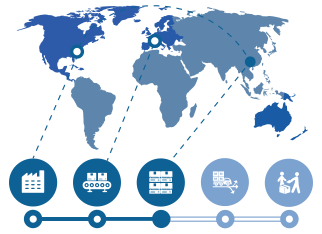
ChoralChain automatically captures and records supply chain data in real time, from upstream to downstream.

Why is it essential?

Tracciabilità End To End

To structure large volumes of data using a common and interoperable language, making information shareable as soon as it is captured.

An automated data management ensures more accurate, complete and up-to-date information, enabling organizations to respond more effectively to market changes and regulatory requirements.

Real-time traceability facilitates the rapid identification of specific product batches or models, safeguarding consumer health and safety.

It demonstrates product authenticity and reduces the risk of counterfeiting.

European and national regulations increasingly require information sharing among all supply chain participants, from suppliers to consumers and competent authorities.

Data sharing between suppliers and customers requires standardized information flows for seamless machine-to-machine communication.

Current and future regulatory requirements affect every stage of the product lifecycle.

La soluzione ChoralChain di Euranet traccia e registra in automatico e in tempo reale dati di filiera da monte a valle.

Qualità, Salute e Sicurezza, Ambiente (QHSE)

La soluzione ChoralChain di Euranet traccia e registra in automatico e in tempo reale dati di filiera da monte a valle.

How does it work?

Come funziona
Once the traceability scope has been identified and mapped, together with the relevant products and supply chains, Euranet defines value-driven KPIs aligned with applicable regulations and international standards.
This is followed by an assessment of the organization's existing information systems (AS-IS Assessment) and a subsequent evaluation of data quality.
The resulting gap analysis allows the definition of the ChoralChain architecture, including ELT integration, achieving a high level of data standardization and alignment.
The ecosystem is then configured through the implementation of GS1 EPCIS and GDSN standards. This ensures ChoralChain is interoperable with any technology.
The effectiveness of digital traceability depends on the ability of systems to communicate using a common language. For this reason, Euranet supports the adoption of GS1 standards, which provide an international framework for identifying, capturing, and sharing information across the supply chain.
In particular, ChoralChain can be integrated with the main GS1 standards and architectures, including:
GTIN – Global Trade Item Number to uniquely identify products, consumer units, and packaging units;
GLN – Global Location Number to identify companies, production sites, warehouses, distribution centers, departments, retail locations, and other relevant supply chain locations;
EPCIS – Electronic Product Code Information Services (ISO/IEC 19987-2024) to record and share traceability events across the supply chain, describing what happened, where, when, why, and which products or batches were involved;
CBV – Core Business Vocabulary (standard ISO/IEC 19988-2024) to provide a common vocabulary to describe EPCIS events, making data more consistent and easier to interpret across different systems;
QR codes and GS1 DataMatrix to link physical products to digital information relating to traceability, authenticity, sustainability, safety, and compliance;
GS1 Digital Link to transform a product identifier into a standardized web link accessible through smartphones, point-of-sale systems, supply chain applications, e-commerce platforms, and digital tools;
GS1 Web Vocabulary to publish structured, machine-readable product data interoperable with search engines, applications, digital platforms, and web systems;
GDSN – Global Data Synchronisation Network to align and synchronize product master data among manufacturers, distributors, and trading partners.

Digital Product Passport (DPP)

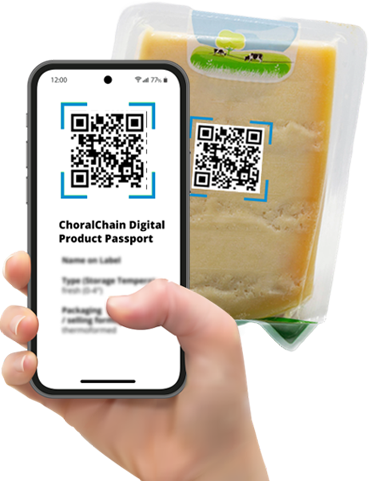
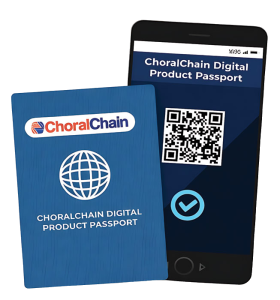
A "digital identity card" in the form of a QR code, that provides access to information about the characteristics and history of a specific product batch or model, from its origin to post-sale activities, automatically drawing data from the ChoralChain traceability system.

With the Sunrise 2027 initiative, the global standard for consumer goods will evolve from the traditional barcode to the GS1 standard QR code, capable of containing a greater amount of information that can be easily accessed via smartphone and read by point-of-sale scanners.

This shift requires companies to gradually adapt their technologies and internal processes to fully leverage the capabilities of the new codes and include more detailed product information within QR codes.

As an official GS1 Solution Partner through ChoralChain, Euranet supports consumer goods companies in the transition to GS1 standard QR codes by the end of 2027. This journey calls for coordinated efforts across the entire supply chain: manufacturers will need to implement the GS1 standard QR codes on product packaging, while retailers will need to ensure that point-of-sale systems are ready to read next-generation codes.

Euranet’s Digital Product Passport

Euranet helps organizations define the data (mandatory and/or voluntary) to include in the Digital Product Passport and the desired level of access. Euranet’s DPP complies with the GS1 Digital Link standard and is interoperable with any technology, supported by the implementation of GS1 EPCIS and GDSN standards.
Lens
How it works: by scanning the ChoralChain QR Code, authorized users can immediately access trusted and verifiable information tailored to their role, including material origin, composition, environmental impact, product certifications, authenticity, and compliance with legal and regulatory requirements, etc.
Enables consumers and supply chain participants to make more informed decisions.
Enhances product value and perceived quality by transparently communicating the story behind each product.

Discover how we create the Digital Product Passport for Consumer Goods

The possibilities are endless... Create your Digital Product Passport with us: the only pass you need to enter the future

ChoralChain traccia e registra in automatico e in tempo reale dati di filiera da monte a valle.

Key Features of the DPP

Accessible by scanning a data carrier (QR Code) that uniquely identifies the product and provides a link to its associated data.

Selective and differentiated access to information (need-to-know approach): organizations decide who can access what.

Information tailored to the B2B or B2C customer scanning the QR Code.

Data protection through cryptographic codes: only authorized parties can access the information, enabling instant information sharing across the supply chain and eliminating paper-based processes.

Data Integrity: information contained in the DPP is authentic, reliable, verifiable, and verified.

Interoperability: information is provided in a standardized format that can interoperate with the IT systems used by companies across the supply chain.

Compliance with the GS1 Digital Link international standard.

Customizable Design: a unique and distinctive DPP can be created in just a few clicks, aligned with the organization's brand identity.


Prepare Today for Tomorrow's Requirements

ESPR

EU Ecodesign for Sustainable Products Regulation (ESPR)

The ESPR Regulation introduces the Digital Product Passport (DPP) as a new European standard for traceability and sustainability, establishing ecodesign requirements that cover the entire product lifecycle.

By 2027/2028, product categories such as batteries, textiles, electronics, steel, furniture, chemicals, tyres, and construction products will progressively become subject to specific DPP requirements.
DPPs will be required to contain critical information relating to product sustainability and circularity (materials, origin, compliance, environmental impact, reuse potential, etc).
Companies (European and non-European) placing ESPR-regulated products on the EU market will be required to structure product data, strengthen supply chain governance, and demonstrate compliance over time.

Euranet supports organizations with an integrated consulting approach throughout the ESPR compliance journey:

Regulatory impact assessment
DPP roadmap definition
ChoralChain solution implementation
Continuous support as regulations evolve
EUDR

EU Deforestation Regulation (EUDR)

The EUDR Regulation imposes Due Diligence, geolocation traceability, and prior declaration obligations for products such as timber, cocoa, coffee, soy, palm oil, rubber, and cattle, including derived products (furniture, paper, chocolate, meat, tyres, and others).
Deadlines:
30 December 2026 (medium and large-sized companies)
30 June 2027 (micro and small enterprises)
Companies (European and non-European) placing EUDR-regulated products on the EU market will be required to collect traceability-related information, data, and documentation (including the geolocation of all relevant plots of land), assess non-compliance risks associated with the products and implement appropriate mitigation measures.

Euranet supports organizations with an integrated consulting approach throughout the EUDR compliance journey:

Regulatory impact assessment and gap analysis
Definition of the traceability and Due Diligence framework
ChoralChain solution implementation
Continuous support as regulations evolve
Foto x sito web (9)
Food Traceability Rule (FSMA Section 204)
The Food Traceability Rule, established under FDA FSMA Section 204, introduces additional recordkeeping and data retention requirements for domestic and foreign companies that manufacture, process, pack, or hold foods included in the Food Traceability List (FTL) and intended for the U.S. market.
Specifically, these companies will be required to record, maintain, and make available structured supply chain information, including Key Data Elements (KDEs - product, batch, quantity, location, links to the traceability lot code, etc.) associated with specific Critical Tracking Events (CTEs - harvesting, cooling, shipping, receiving, etc.) throughout the supply chain.
The FDA further requires this information to be made available within 24 hours of a request, or within another reasonable timeframe agreed with the authority.
20 July 2028 is the compliance deadline for the Food Traceability Rule.
For companies exporting or planning to export to the United States (or operating within supply chains serving the U.S. market) the traceability requirements established by the FDA represent a strategic opportunity to reduce risk, prevent trade disruptions, and ensure continued access to international markets.
Euranet supports organizations with an integrated consulting approach throughout the Food Traceability Rule compliance journey:
FDA FSMA 204 applicability assessment
Process mapping
Development of a traceability model capable of linking events, batches, products, locations, operators, documents, and relevant information across the entire supply chain
Continuous support as regulations evolve
Implementation of the ChoralChain solution, which for Food Traceability Rule compliance enables organizations to:
a. identify products through GTINs and companies, facilities, warehouses, and locations through GLNs;
b. record critical events and the relevant data associated with them, including links to batches and traceability lot codes;
c. securely share information with partners, customers, and authorities;
d. prepare exportable data that can be used for audits, inspections, recalls, or FDA requests.
ChoralChain is Euranet's innovative solution that will help you navigate today's regulatory landscape and comply with the Food Traceability Rule, ESPR, EUDR, and other regulatory requirements.
Staying ahead of compliance means reducing risk and turning obligations into a competitive advantage.

Regolamento UE EUDR contro la deforestazione

Il Regolamento EUDR impone obblighi di Due Diligence, tracciabilità geografica e dichiarazione preventiva per prodotti come legno, cacao, caffè, soia, olio di palma, gomma e bovini, inclusi i derivati (mobili, carta, cioccolato, carne, pneumatici e altri).
Sveglia
Scadenze:
30 dicembre 2026 (medie e grandi aziende)
30 giugno 2027 (micro e piccole aziende)

Euranet accompagna le imprese con un approccio consulenziale integrato lungo l’intero percorso di adeguamento a EUDR:

Analisi dell’impatto regolatorio e connessa Gap Analysis
Definizione del modello di tracciabilità e Due Diligence
Implementazione della soluzione ChoralChain
Supporto continuo nell’evoluzione normativa

ChoralChain è una soluzione innovativa e rivoluzionaria di Euranet che ti supporterà nell’attuale complesso quadro regolatorio, consentendoti di adempiere a tutti i requisiti dei Regolamenti ESPR, EUDR e non solo.
Anticipare la compliance significa ridurre il rischio e trasformare l’obbligo in vantaggio competitivo.

Euranet © – All rights reserved
Euranet S.r.l. Registered Office: Via Boccaccio 20, 20123 Milan, Italy – Operational Office: Via Cavour 5, 27043 Broni (PV), Italy – Share Capital €64,100 fully paid-up – VAT No. 12270030153 – Registered with the Milan Companies Register, REA MI-1544390
crossmenu